Biography
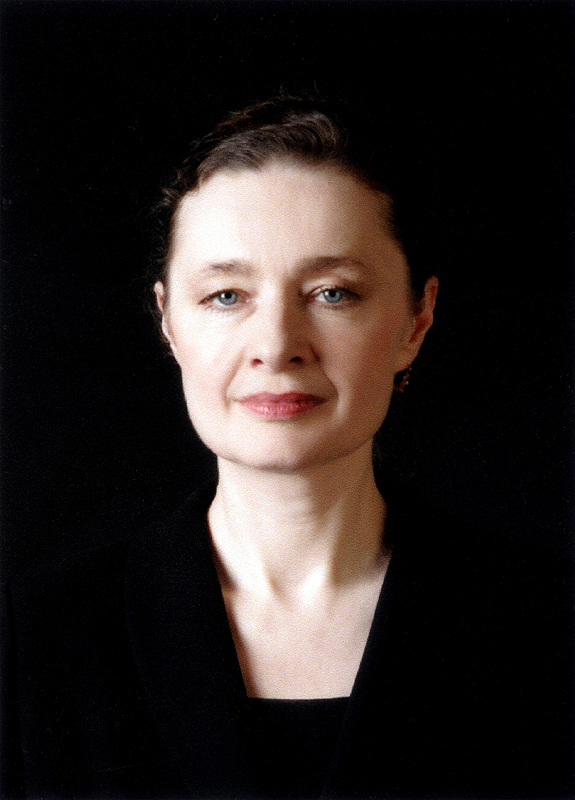
Ewa Iżykowska, singer (soprano, mezzo-soprano), actress, born 5 September 1955 in Olsztyn. She graduated from the Fryderyk Chopin Academy of Music in Warsaw, where she studied solo voice, and from the Aleksander Zelwerowicz National Academy of Dramatic Art in Warsaw, earning her diploma with distinction.
As a singer she studied under Prof. Lidia Małachowicz, Prof. Kazimiera Goławska, and Prof. Ewa Wdowicka. She continued her training at the Accademia Chigiana in Siena, Italy under Giorgio Favaretto and Ettore Campogalliani, and subsequently at La Scala in Milan under Giulietta Simionato, Eduardo Mueller, and Antonio Tonini.
In 1981 she made her debut at La Scala in the title role of Donizetti's Rita. During this period, after winning a competition, she took part in the Italian summer stagione in Alessandria, performing the role of Fiordiligi in Mozart's Così fan tutte, conducted by Eduardo Mueller, with Mauro Trombetta as Don Alfonso.
Ewa Iżykowska is a laureate of numerous national and international competitions, including the Karol Szymanowski National Music Competition, the Belvedere Competition in Vienna, and the Mozart Competition in Alessandria, Italy.
She made her Polish debut in 1979 as Fiordiligi in Mozart's Così fan tutte at the Musical Theatre in Słupsk, conducted by Grzegorz Nowak and directed by Ryszard Peryt. In 1981 she took part in the world premiere of Zbigniew Rudziński's The Mannequins at the Wrocław Opera, conducted by Robert Satanowski and directed by Marek Weiss-Grzesiński.
From 1982 she was affiliated with the Grand Theatre in Poznań, where she created her portrayals of Violetta in Verdi's La Traviata, Rosalinde in Johann Strauss's Die Fledermaus, Blonde in Mozart's Die Entführung aus dem Serail, Micaëla in Bizet's Carmen, Liù in Puccini's Turandot, Lisa in Lehár's Das Land des Lächelns, Arsena in Johann Strauss's Der Zigeunerbaron, Musetta and Mimì in Puccini's La Bohème, and Hodel in Fiddler on the Roof.
She received the City of Poznań Award for Young Artists in the same year as Jan A. P. Kaczmarek, with whom she recorded the album Halley's Comet during that period.
In 1986 she debuted at the Vienna Kammeroper as Nedda in Leoncavallo's Pagliacci, directed by Georg Tabori. The production was hailed by Viennese critics as the production of the year 1986.
Her subsequent roles at the Vienna Kammeroper included the Countess in Mozart's Le nozze di Figaro, Dorlisca in Rossini's Torvaldo e Dorlisca, and Violetta in Verdi's La Traviata.
From 1987 to 1991 she was a soloist at the opera in Lucerne, Switzerland. On that stage she sang roles including the Countess in Mozart's Le nozze di Figaro, Poppea in Monteverdi's L'incoronazione di Poppea — with tenor Ramón Vargas as Nerone — Adriana in Cilea's Adriana Lecouvreur conducted by Marcello Viotti, Tatyana in Tchaikovsky's Eugene Onegin, Blanche in Poulenc's Dialogues des Carmélites, Saffi in Johann Strauss's Der Zigeunerbaron, and Hanna Glawari in Lehár's Die lustige Witwe.
In 1991 she resumed her collaboration with the Grand Theatre in Poznań, as well as with the Grand Theatre in Warsaw, the Wrocław Opera, and the Kraków Opera, where she sang roles in operas by Richard Strauss — Salome in Salome and the Marschallin in Der Rosenkavalier — and by Penderecki: Benigna in Die schwarze Maske, Eve in Paradise Lost, and Mother Joanna of the Angels in The Devils of Loudun.
Mimì and Musetta in Puccini's La Bohème, Flora in Orefice's Chopin, Galina in Landowski's Galina, and Rachel in Halévy's La Juive.
During this period Ewa Iżykowska also became a performer of monumental oratorio and cantata works, including Verdi's Requiem, Mahler's Symphony No. 8 — Soprano I, II, and III parts — Richard Strauss's Four Last Songs, Górecki's Symphony No. 3, and works by Penderecki: Te Deum, Dies Irae, Utrenja, and Seven Gates of Jerusalem, as well as Beethoven's Symphony No. 9 and Missa Solemnis, and Shostakovich's Symphony No. 14.
She also turned her attention to chamber music, and from 2000 to 2002 she undertook a world tour with recital programmes of Chopin and Paderewski songs, as well as From Baroque to Jazz.
In 2000–2001 she took part in the production of Rudziński's The Mannequins at the Grand Theatre in Warsaw. In 2005 she performed as Tosca in Puccini's Tosca in South Korea.
She has collaborated with distinguished pianists including Krzysztof Jabłoński, Marek Mizera, Jerzy Maciejewski, Janusz Olejniczak, Marek Drewnowski, Caroll Hague, Vincenzo Scalera, and Giorgio Favaretto.
She has also worked with eminent conductors such as Josef Gielen, Marcello Viotti, Eduardo Mueller, Grzegorz Nowak, Krzysztof Penderecki, Antoni Wit, Jacek Błaszczyk, Karol Stryja, Pierre Romansky, Jacek Kasprzyk, Oliver Quendet, Gabriel Chmura, and others.
She has appeared on concert and opera stages alongside such outstanding artists as Ramón Vargas, Mauro Trombetta, Reinhardt Brussmann, Louis Gentile, Yvonne Naef, and others.
Over many years she has participated in premieres and performances of works by contemporary composers including Ottavio Vásquez, Jan A. P. Kaczmarek, Zbigniew Rudziński, Stanisław Moryto, Krzysztof Penderecki, and Henryk Mikołaj Górecki.
She has made numerous recordings for Polish Radio, Radio Vaticano, Radio Suisse Romande (Rossini's Il Signor Bruschino, conducted by Marcello Viotti), Russian radio and television (Penderecki's Utrenja), and television networks in the Philippines, Brazil, and South Korea, as well as for Italian television RAI (Mozart's Così fan tutte) and Austrian television ORF (Penderecki's Dies Irae, conducted by Josef Gielen, and Leoncavallo's Pagliacci, directed by Georg Tabori).
She has participated in worldwide radio broadcasts of Penderecki's The Devils of Loudun and Die schwarze Maske, and Mahler's Symphonies No. 2 and No. 8.
She is also dedicated to pedagogical work. She is a Professor at the Fryderyk Chopin University of Music in Warsaw. For four years she worked in South Korea, where she served as Director of the Keimyung–Fryderyk Chopin Academy of Music programme at Keimyung University. She has conducted master classes in the USA, Italy, South Korea, Austria, and Poland. She is also a lecturer at the Polish Academy of Sciences.
Ewa Iżykowska
© 2026 Ewa Iżykowska